
Utah County Deed Records by Instrument
A recorded deed is evidence only. It shows what the Utah County Recorder accepted, not an opinion on title. Warranty deeds carry the label WD in the index. Liens, plats, abstracts, and other instruments surface too. Land Records sorts these through a kind-of-instrument mode or a description mode. The form does not publish its full dropdown list in advance, so search live rather than assuming every instrument carries a known code.
| Deed Type | What It Does | Common Use |
|---|---|---|
| Warranty deed | Conveys the interest stated in the instrument, with its promises | Review a recorded transfer |
| Quitclaim deed | Transfers whatever interest the grantor has, if any | Family or title cleanup context |
| Mortgage / deed of trust | Records a security interest tied to land | Check for a later release |
| Release / assignment | Shows a later change to a recorded interest | Follow the lien or loan record |
| Plat or tax-sale instrument | Maps lots or records a sale-related event | Pair with parcel and legal description |
A deed and a mortgage are different records. The first names the parties to a transfer. A mortgage or deed of trust records a security interest instead. A release or satisfaction comes later as its own instrument, so a payoff alone does not prove the county index holds the release. Search Utah County by party, parcel, and instrument type, then read the full document. Never rely on the short description alone.
Search Utah County Recorder Instruments
Utah County separates recorder searches by the clue you hold. Documents by Name finds recorded parties. An entry number or date narrows a known filing. KOI search sorts by kind of instrument. A document/parcel cross-reference joins a serial number to an entry, but the tools expose different menus, so the assessor's owner or address search will not necessarily return the deed image itself.
| Utah County field | Entry type | Use |
|---|---|---|
| Documents by Name | Party name | Find recorded grantors, grantees, and other named parties |
| Document Recording Search | Entry number or date | Locate a known recording event |
| KOI Search | Instrument code or description | Filter by document kind; optional starting date |
| Document/Parcel Cross-Reference | Serial or entry | Link a parcel to recorded entries |
The Utah County KOI form shows the instrument choices. It also offers recording-date filters, and without a date the newest items return first, so set one when you are working within a known period.
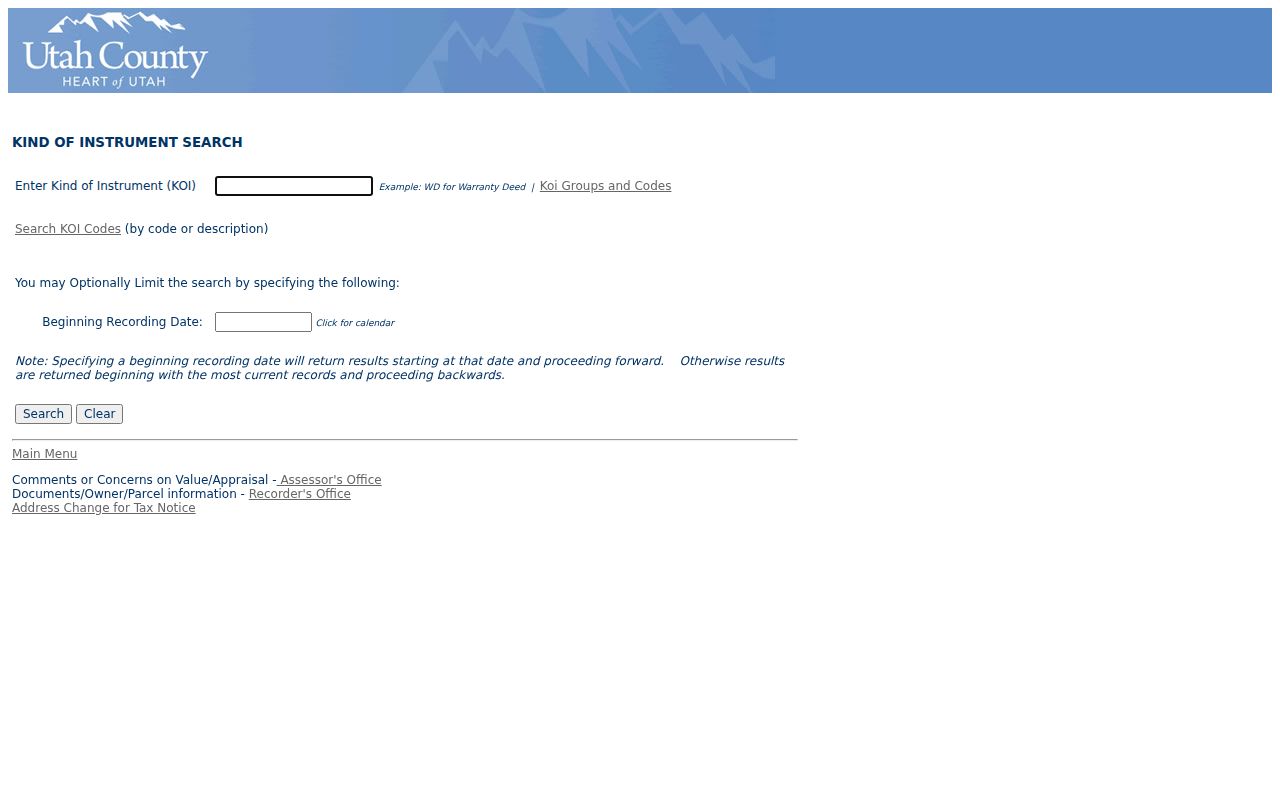
Read the full description and entry details first.
Utah County Recorded Deed Fields
A deed index result can show an entry or document number, recording date, party names, an instrument code or description, document location, book and page, a parcel cross-reference, and an image link where available. Sample party values depend on the search. Copy the entry number and date into your notes. Then compare the full image with the current legal description. A bare name match can mislead. It may point to another Utah County property.
Book and page references suit older material. The online interface also asks for an entry number and year to display an image. If the image is missing, the index still helps the Recorder find a paper or film source. The office publishes copy charges. Image availability and the earliest index date vary, so ask the Recorder directly.
Use the Utah County Party Index
The party index is one route through Utah County's recorded chain. Search the current owner as grantee first. That finds the acquisition deed. Then run the prior grantor as a new grantee, matching the legal description each time. A parcel that was split or combined can pull a name-only sequence onto a different tract. The county names no single earliest year. So the last online result is not a certified start of the property's history.
- Start with the parcel serial and locate the latest likely deed entry.
- Read the parties and legal description from the image or full index detail.
- Search the prior grantor as a grantee in an earlier deed.
- Repeat while the tract description still matches, noting estate, trust, or entity names.
- When the online trail ends, ask about abstract books, plats, and archive holdings.
- Grantor
- The person or entity transferring the interest stated in a deed.
- Grantee
- The person or entity receiving that interest.
- Chain of title
- The sequence of recorded instruments used to trace ownership backward or forward.
- Book/page vs. instrument
- Two references used by Utah County’s recorder tools for locating a filing.
Utah County Older Books and Plats
Historic land research in Utah County can run through several collections. REDI Book material covers 1976–1977. Recorder abstract images sit alongside it. So do 2016 plat images, city surveys, mining indexes, water-rights records, and typed abstracts. The public pages give no earliest years for each index. Reel numbers for older deed books are absent too. Ask the Recorder for help. The office can say which vault or image series fits the book, page, plat, or legal description you found.
The scanned plat index holds city surveys for Provo, Orem, Lehi, and other towns. It also holds subdivision groups. A house history starts from the current serial. Follow it to the abstract. Note the oldest entry, then compare its legal description with the older plat. A newspaper, directory, obituary, or census adds context, but context is not proof of title. The Utah County plat index provides the city-survey scans. The State Archives land guide explains how collections can overlap.
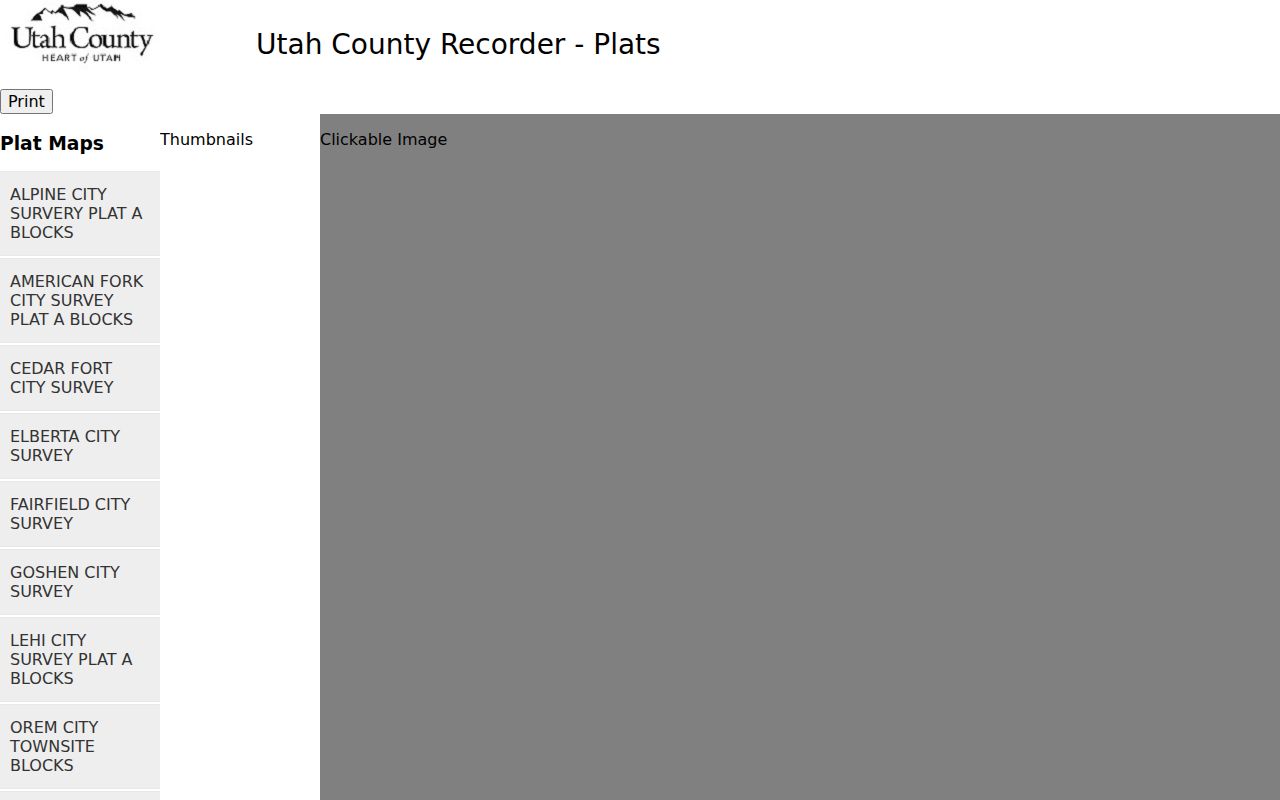
A city survey can explain an old lot description. Read it before you follow the chain into later subdivision records.
Utah County Property Watch Limits
Property Watch sends a free email alert whenever a recording is fully processed. It fires when that recording touches a subscribed serial or a name search. Utah County labels it a courtesy feature, and that wording matters. An alert can miss a filing entirely. It is not fraud prevention either. Treat any alert as a prompt, not proof. The validation lives in the actual Recorder entry and its image. Neither an alert nor a title question is settled until you open them.
Pull the serial from the deed or the assessor card before subscribing. A name-only match can easily point to someone else's Utah County parcel. For a known parcel, the alerts work well as simple monitoring. The legal effect of a new deed or lien still rests on the instrument itself. The surrounding record carries the rest. If you are tracing ownership backward instead, the former-owner record route explains how to follow each prior grantee. The Property Watch page posts the subscription form and its stated limits.
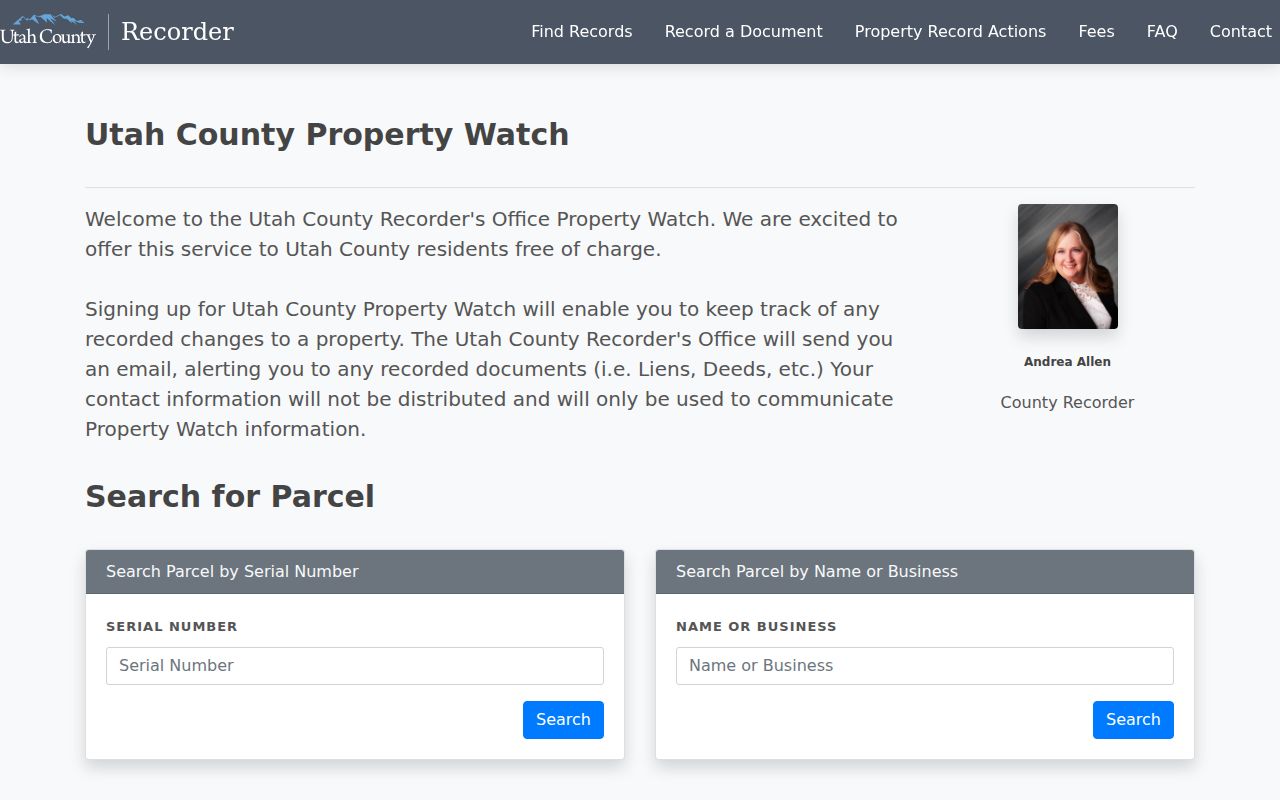
Keep the alert as a prompt to review the matching recorded entry in full.
Utah County Court Files beside Deeds
A recorded deed is rarely the whole story in a land dispute. Foreclosure, quiet title, partition, lis pendens, probate fights, and lien enforcement all live in Utah Courts Xchange. It is searchable by party or case number. Xchange is not parcel-oriented. So search a grantor, grantee, plaintiff, or estate name instead. Then read the docket for a legal description or serial that ties the case to land. Most district-court documents filed electronically since July 1, 2010 sit online. Older converted cases can be thinner.
Free public terminals offer another route to case summaries. Find them at most district courthouses and the Utah State Law Library. Paid online accounts carry separate search and document charges. A judgment in court and a recorded release can both affect the same parcel. The parcel must sit in Utah County for both to matter. Compare the docket against the Recorder index. Do not treat one as a substitute for the other. The Xchange account page spells out guest options, subscriptions, and document fees.
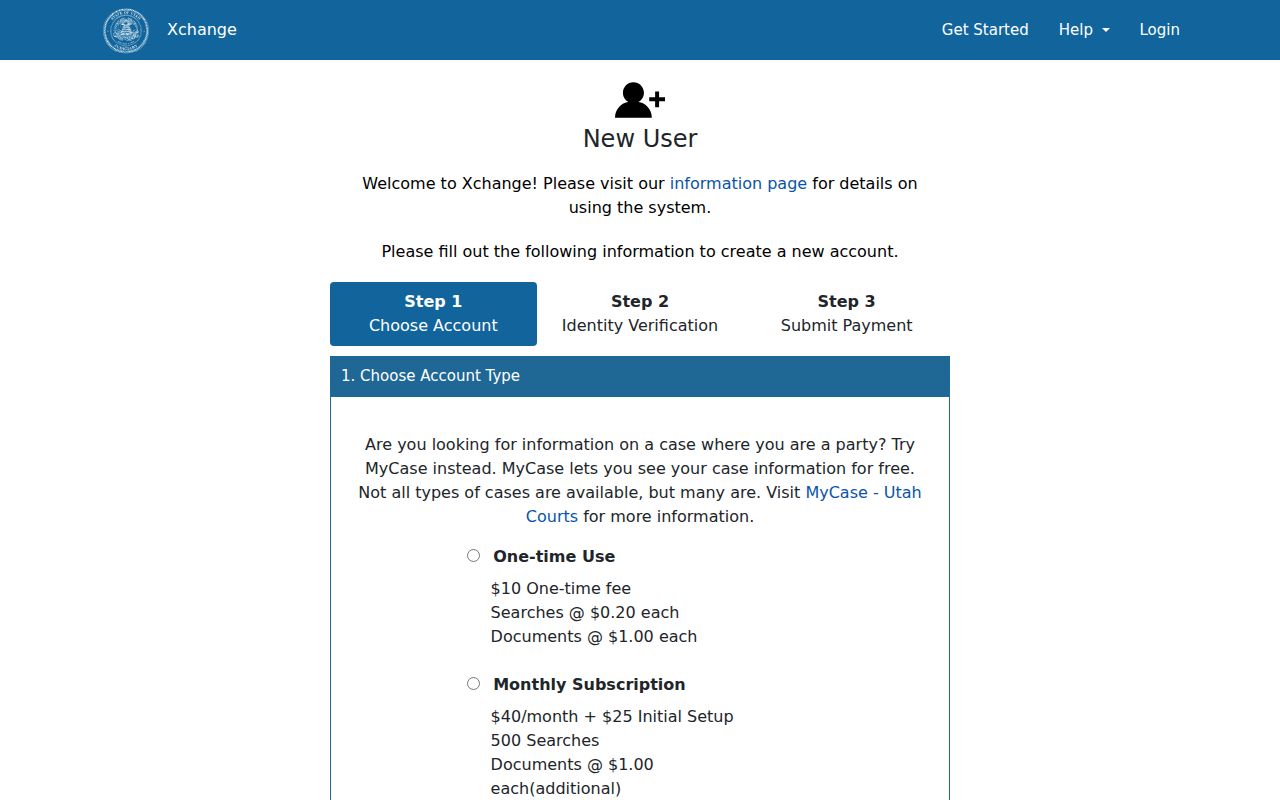
Use the courts for case history; use the Recorder for recorded land documents.
Get a Utah County Deed Copy
Start with identifiers. The entry number, book and page, party names, recording date, or parcel serial will get you a usable deed copy. Use the image link whenever the Recorder tool offers one. The online screen may not yield the copy. If not, contact the Recorder at 100 East Center Street, Suite 1300, Provo, UT 84606, or 801-851-8179. The county schedule lists a one-dollar land-record document copy. Confirm certified-copy terms and current charges with the office directly.
A copy request should name the instrument precisely. Include enough detail to separate it from other Utah County filings. Recording a new instrument is a different transaction. That path requires an original document with signatures and notarization. Copy requests do not. Keep the legal description and return address from the document in your notes. Ask whether an image, paper copy, or certified copy exists for that entry.
Party-name searches often return several plausible instruments. Compare the recording date, entry number, book and page, parcel cross-reference, and legal description before choosing. One deed can cover multiple parcels. It can also convey less than a full fee interest. The grantee line alone may not tell you what changed. The Recorder's index is only the path. The complete document holds the operative language. When an older book reference is all you have, give it to the office. Do not guess a newer serial or substitute a similarly named filing.
Recorded, not guaranteed. The Utah County deed index shows recorded instruments, not every possible interest or a final title opinion. Have a title professional review the full chain when certainty is required.