
Utah County Property Tax Record Fields
Utah County splits each tax record across two offices. The Assessor keeps the value record. The Treasurer keeps the account detail. Market or appraised value is the Assessor's estimate, while assessed and taxable values reflect the tax roll and any exemption applied. A delinquent payoff adds every amount due through a date you choose, so read the year and field name before comparing two Utah County property tax records.
| Field | What It Shows | Where |
|---|---|---|
| Market / appraised value | Assessor estimate of full market value | Assessor Land Records |
| Assessed / taxable value | Tax-roll value after applicable treatment | Assessor value screens |
| Residential exemption | Primary-residence treatment and declaration | Assessor |
| Tax history and bill | Annual tax detail and payment status | Tax Information |
| Delinquency / payoff | Balance, penalties, fees, interest, total by date | Delinquent Tax Search / Tax Payoff |
These figures do not swap freely. Utah County's primary-residence exemption usually removes 45% of fair-market value from taxation. That leaves 55% taxable before the local rate applies. A tax bill depends on more than the value field. A recorded sale price is only a past transaction. Use the value page for meaning and the tax screens for charges due.
Utah County Primary Residence Exemption
Utah County applies a 45% primary-residential exemption to most homes. The occupancy rule comes first. The assessor describes primary use as the owner, a spouse, a family member, or a full-time tenant living in the home. That stay must run at least 183 consecutive days. That leaves 55% of fair-market value taxable. The local rate applies after that. This is not a flat discount off the final bill. The Assessor sets no tax rates and collects no payments.
A different mailing address can trigger a declaration. The rule sits in Utah Code §59-2-103.5(8). The county says the form is generally due within 90 days of its letter. A missed response can shift the parcel to secondary-residence treatment. Verify the status on the live parcel record. Do not assume an old exemption still stands.
The Utah County residential exemption page explains the occupancy test and declaration steps in full. Its example shows why market value and taxable value can differ. The gap is the exemption at work.
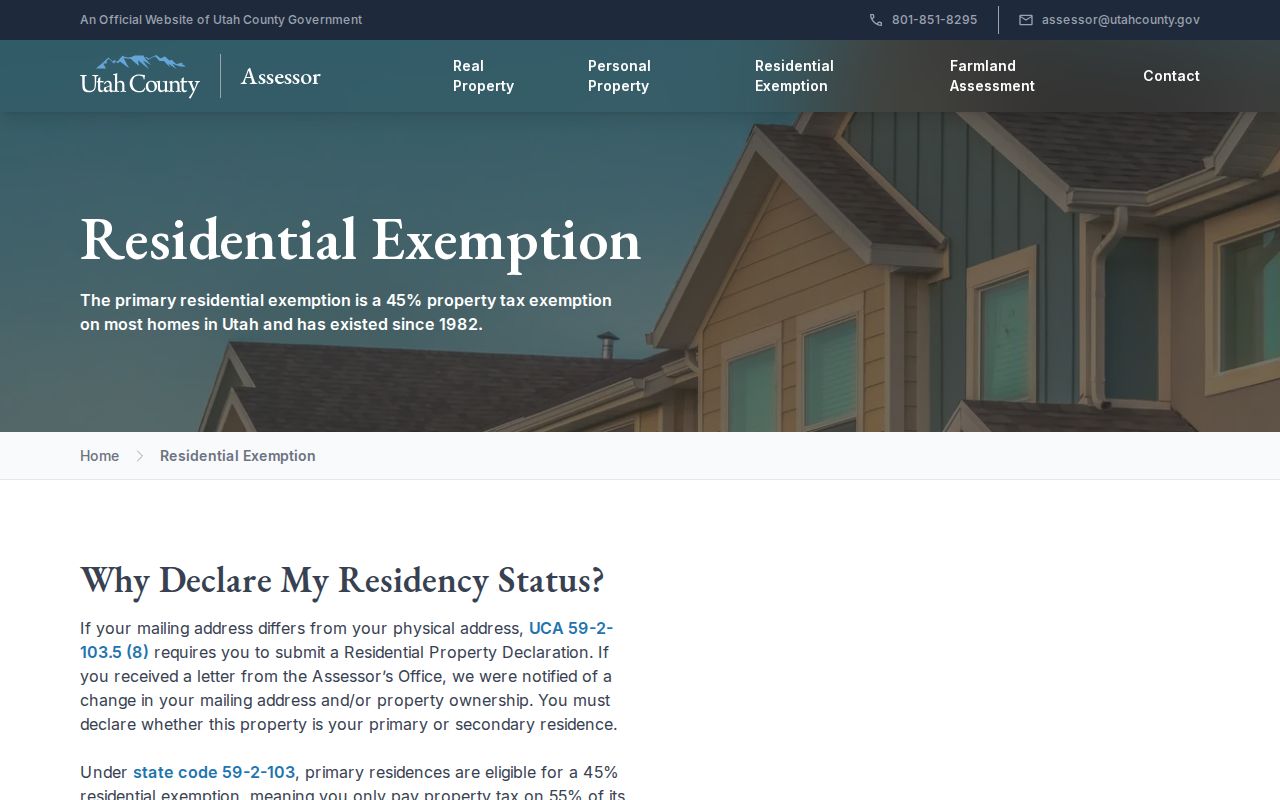
Use the current parcel’s exemption field to see how the county treated that property.
Utah County Tax Notice Calendar
The calendar ties the value notice to the bill. Valuation notices go out around July 22. Board of Equalization hearings run in August. Assessment appeals are due September 1. Tax notices arrive around October. Real-property tax is due November 30. A delinquency penalty starts December 1. These are the county's ordinary dates; check the live notice for current-year changes.
A value that looks wrong deserves a quick response. Preserve the notice, compare its property facts with the record, and direct any appeal to the Board of Equalization before the posted deadline. Follow the official county instructions on evidence rather than assuming one comparable-sales format. The Treasurer tax-information calendar lays out the full sequence of notices, appeals, bills, delinquency, and sale activity.
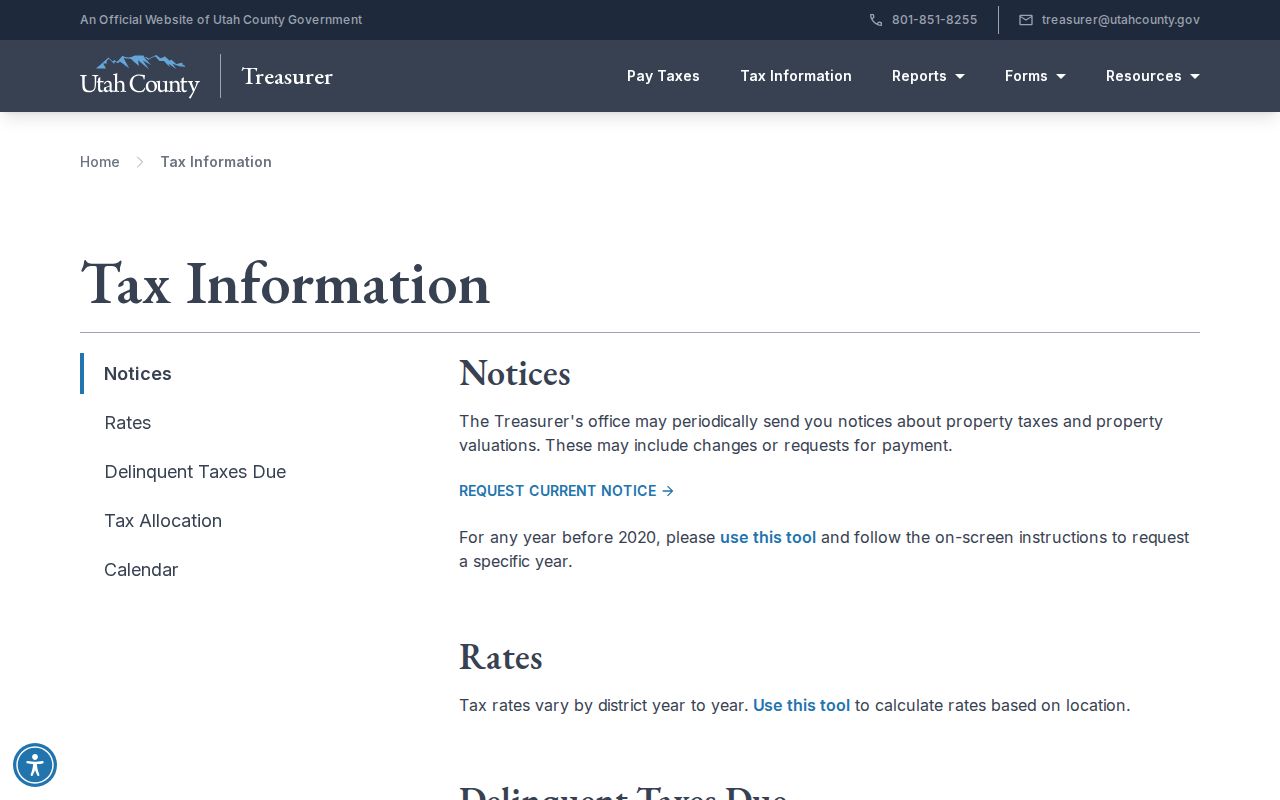
Pair the calendar with your valuation notice. That keeps the assessed year and appeal window straight.
Find Utah County Tax Screens
Land Records splits its tax tools into separate modes. Property Values and Property Valuation cover assessor values. Tax Information, Delinquent Tax Search, and Tax Payoff follow the tax account. The parcel serial is the clearest link between them. The Treasurer also posts the calendar and tax-sale details outside that menu.
| Mode | Key or detail | Question it answers |
|---|---|---|
| Property Values | Parcel serial | What value history is listed? |
| Property Valuation | Parcel serial / notice | Which assessment notice is available? |
| Tax Information | Parcel serial | What is the annual tax record? |
| Delinquent Tax Search | Owner name | Is a delinquent account listed? |
| Tax Payoff | Serial and payoff date | What is due through that date? |
For an address-to-serial path, start with the Utah County property search. Never mix tax years when comparing.
Open a Utah County Tax Bill
Use the parcel serial to move between assessor and Treasurer screens. If the address is all you have, find the parcel first, then check the bill, payment status, and payoff date. The Utah County Treasurer lists contact numbers 801-851-8255 and 801-851-8264 at 100 East Center Street, Suite 1200, Provo. A call or office request can help when the online result does not answer which tax period or charge is shown.
- Find the Utah County parcel serial from the address or owner-name search.
- Open Tax Information for the annual bill and tax history.
- Check the assessor value and exemption screens for the same serial.
- If a balance is delinquent, open Tax Payoff and record the calculation date.
- Check the Auditor’s May sale list if the parcel appears in a sale notice.
- Assessed value
- The value used on the tax roll; it can differ from market value.
- Taxable value
- The portion subject to tax after a qualifying exemption.
- Residential exemption
- The Utah County reduction for qualifying primary use, subject to its occupancy rule.
- Payoff
- A dated total that may include balance, penalty, fees, and daily interest.
Utah County Daily Payoff and Delinquency
A tax payoff is never a fixed balance. A Utah County result can list delinquent years, tax balance, penalty, fees, and interest, with a total computed as of a chosen date. Interest accrues daily. A figure copied from an older screen may no longer clear the account. Save the serial and payoff date with the number.
The Treasurer sets the cycle. Taxes are due November 30, and a delinquency penalty begins December 1. Parcels delinquent five years move toward the May tax sale, and March 16 marks forwarding to the Auditor. That path explains why one parcel can appear in an annual bill, a payoff result, and later a public sale list. Check the county's current notice for exact cycle details.
Utah County May Tax Sale Records
The Auditor runs a May tax sale each year. The properties are at least five years delinquent. The public list can show the parcel, tax district, current owner, and owner mailing address. Payoff amounts and property pages appear too. Newspaper notice runs four weeks. Redemption before bidding requires certified funds. Once bidding starts, county material says there is no post-sale redemption. Verify every current-year rule before acting.
Treat a tax-sale row as a lead, not proof. A row does not show that a transfer happened or that title is clean. Compare the parcel serial and legal description against Recorder deed records. Watch the addresses: the notice may list a mailing address rather than the property situs. The county also posts protest and excess-funds information. Those links explain the correct process better than any copied row. The Utah County May tax-sale page carries the current list and procedures.

Check the official sale list for a parcel's status and follow the county's redemption instructions.
Ask Utah County about Tax Records
Start with the right office. The Assessor handles values and exemptions, not collection or tax rates. Its Provo office sits at 100 East Center Street, Suite 1100. Reach it at 801-851-8295 on weekdays from 8 a.m. to 5 p.m. For bills and payoffs, use the Treasurer in Suite 1200 at 801-851-8255 or 801-851-8264. Assessment questions go one way. Billing questions go the other.
When a record is not online, use Utah's GRAMA request process. It applies to the agency that holds it. Name the parcel, tax year, and record type in the request. Inspection, copies, or staff research may cost a fee under the agency schedule. The Utah GRAMA resource lists request channels and the general fee schedule.
Appeal a Utah County Assessment
Utah County sends valuation notices around July 22. Board of Equalization hearings follow in August. The appeal deadline lands on September 1. Use the notice and current county instructions. Pin down the parcel, the value year, and the filing route. Confirm acceptable evidence and the current form inventory with the Auditor or Assessor before filing.
Keep the valuation notice with the parcel serial and the year at issue. Check the property characteristics on that notice against the county record. Then name the exact value entry you dispute. A current tax balance is not a substitute for the assessment itself. A prior-year sale is not either. A timely appeal travels through the Board of Equalization process. A phone call after the deadline replaces nothing. If the issue is an exemption, an address declaration, or a tax payment, take it to the office that owns it. Do not frame it as a value appeal.
Appeal window. Utah County assessment appeals are due September 1. Check the current notice for filing steps and retain proof of submission.