
Trace Former Owners by Deed
To find former owners, pull the most recent deed on the parcel. Step backward one grantor at a time. That is the whole method. The table below is a chain. Fill it in row by row, and every row should come from an actual recorder result rather than a guess. Keep the legal description in view as you go. A live parcel search should come first. Plugging in transfers that were never recorded only breaks the chain.
| Chain position | Transfer date | Grantor → grantee | Instrument | Book/page or entry |
|---|---|---|---|---|
| Latest matching deed | Use recording date | Read named parties | Use instrument type | Copy shown reference |
| Prior acquisition | Use earlier date | Current grantor becomes grantee | Read deed image | Save its reference |
| Earlier transfer | Continue backward | Match the same tract | Note estate or entity | Check prior book or entry |
The online party and parcel tools work well. They keep returning the same legal description. Utah County publishes no single earliest year for every sub-index. Once the web trail runs dry, ask the Recorder about abstract images. Ask also about the older books. Historic plats and the Utah State Archives land guide come next. The custodian may never state a year range. Leave it unknown rather than inventing a cutoff.
Utah County Grantor-Grantee Steps
A backward chain simply turns each grantee into the next grantor. Search by parcel serial or by party name. Then open the entry and read the full image. The deed that gave the current owner the land names the prior party. Find that party's earlier deed, and the same land should appear moving into their name. Carry the legal description through every search. A street address can change, and a split or merger can shift the serial.
- Find the latest Utah County deed that matches the serial and legal description.
- Record its date, grantee, grantor, instrument type, and book/page or entry number.
- Search the grantor as a grantee in an earlier Recorder result.
- Check that the lot, block, or metes-and-bounds description still matches the parcel.
- Repeat until the online result ends, then ask where the older volume is held.
- Grantor
- The party conveying the interest named in a deed.
- Grantee
- The party receiving that stated interest.
- Chain of title
- The linked set of instruments used to trace a parcel’s transfers.
- Quitclaim deed
- A transfer of whatever interest the grantor holds, if any.
- Legal description
- The lot, block, or written boundary description that identifies the land.
Utah County Parcel Serials Can Change
A split, a merger, or a condominium creation can strand older deeds under a parent serial. It can also strand them under an older legal description. Utah County Serial History helps bridge a current number to earlier parcel-system entries. Note one common trap. The historic GIS date marks when the parcel entered the online property system. It does not mark when the deed recorded. Keep those dates apart while tracing former owners.
When a current serial returns nothing, search the older chain by its prior legal description instead. Compare the subdivision or city-survey name, the lot and block, and the party names. A replat can rewrite a tract description. So read the recorded plat before concluding the chain has a gap.
Utah County Historic Plats and Abstracts
The Recorder plat index covers city surveys and subdivision groups. Among them are Provo City Survey plats, Orem Townsite Blocks, and Lehi City Survey Plat A Blocks. Land Records also links REDI Book material from 1976–1977. It adds selected recorder abstract images, 2016 plat scans, mining indexes, typed abstracts, and water-rights documents. These collections show how an older deed described land before any current address or serial existed.
Start from the current serial to reach an abstract or cross-reference. Note the oldest deed you can see. Then compare its legal description against the plat. The Utah County scanned plat index leads straight to city and subdivision map images.
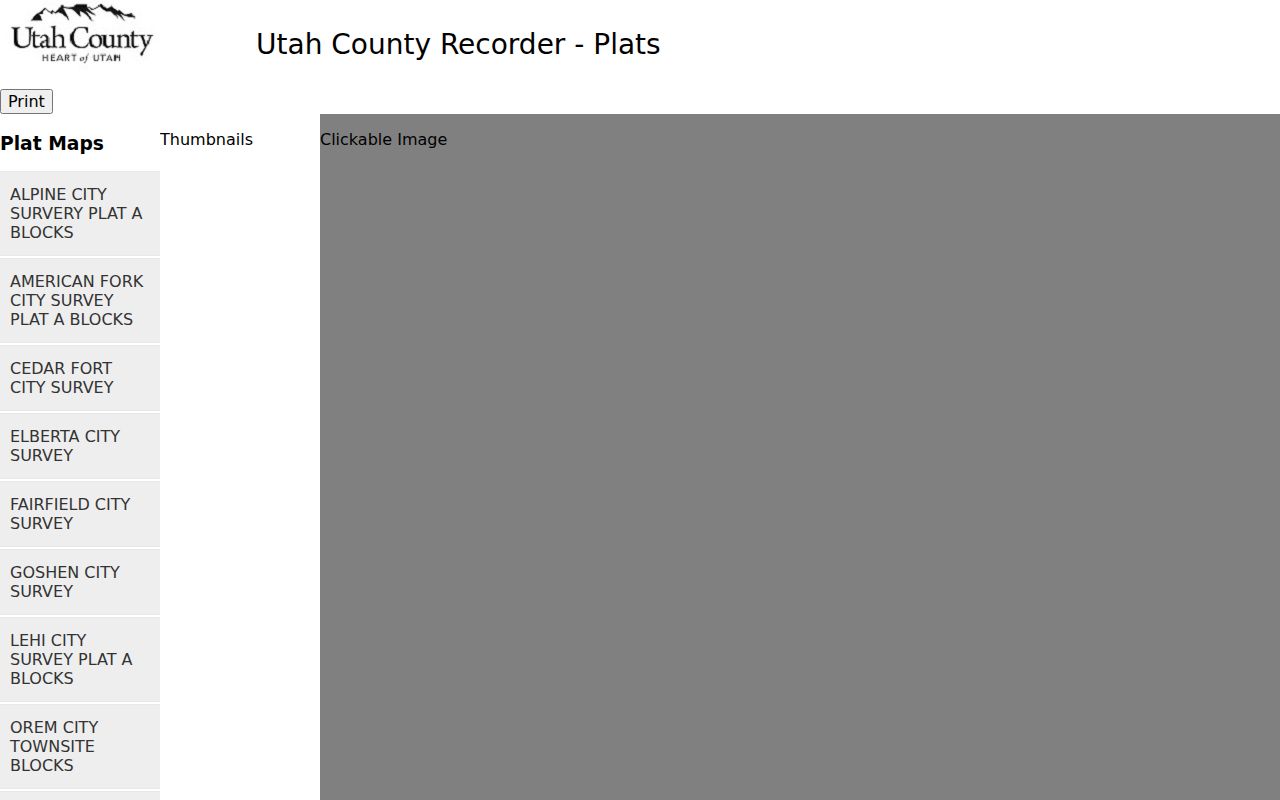
A city survey can preserve lot and block names that a modern street address never shows.
Utah County Archive Fallbacks
When an online Utah County deed search hits its limit, ask the Recorder about vault, book, abstract, film, or copy options. Use the names and references already in hand. Then turn to the Utah State Archives land guide, the FamilySearch catalog, BYU collections, Provo City Library, and Utah County Library. These sources hold older land material. Ask archive staff by record type and known party. Exact reel numbers, collection identifiers, and directory years are not published. Request help directly rather than citing a guessed shelf or year.
Newspapers, obituaries, cemetery indexes, directories, and local-history files can flesh out former owners. They enrich a house history but never replace a recorded deed. County online images can stop short of the period you need. The State Archives land guide is then the sensible next step.
A name search that returns no older deed does not prove no earlier transfer happened. Try full spellings, initials, middle names, and business or trust forms. Also try any representative named in a later instrument. Then compare a book-and-page reference or legal description from the older document against the current serial history. No single earliest online year exists for every index. Report the range actually checked and ask the Recorder or archive staff about the specific record series when a gap remains. The Utah State Archives land-record guide also describes the collections and explains how to place a request.
Use the archive guide to find the next custodian before assuming an older owner record is lost.
Utah County Estate Chain Breaks
Not every ownership chain runs from buyer to seller. Some former-owner trails in Utah County pass through an estate. Others pass through a trust, or a business instead. Probate petitions, letters of appointment, and inventories surface in Utah Courts Xchange. Executor deeds and final distributions get recorded with the Recorder.
Search the decedent first. Add the estate, executor, and beneficiary names next. Then match that docket to the parcel. Recent death certificates are restricted under qualifying-access rules. So the probate docket plus the recorded deed usually carry the work. If the chain shifts from a person to an estate or entity, copy that name exactly. Keep searching under the named representative.
Utah Courts Xchange is a case index, not a parcel ownership database. Treat a matching estate or party name as a lead. Check the case type, parties, filings, and dates before tying anything to a parcel. Then check the Recorder's index. The court file explains the authority behind a transfer. The recorded instrument shows what was filed against the property.
Pull the docket there first. Start any probate or civil docket at the Utah Courts Xchange public case search. The filings you find should lead to the deed that follows. The court record explains the authority behind a transfer. The recorded instrument shows what was filed against the property. Names must match exactly throughout.
Use a court result to follow the estate record, then confirm any property transfer in the county deed record.
Follow the Utah County Deed Chain Backward
Work backward from a present parcel. Utah County's Recorder route starts at the newest recorded party and steps toward earlier ones. Use Documents by Name for a party. Document/Parcel Cross-Reference works for a serial or entry. KOI covers instrument kind, and a book/page reference suits older material. An image often shows more. Keep the date, instrument, parties, and legal description together at each step.
- Read the latest likely deed and confirm its parcel description.
- Search the deed’s grantor as the grantee on an earlier transfer.
- Repeat, checking name variants and legal descriptions at every step.
- Record the oldest online reference and ask the Recorder about the next source.
- Grantor / grantee
- The named transferor and recipient of the stated interest.
- Chain of title
- The ordered record trail for one tract of land.
- Legal description
- The land description used to test whether two deeds refer to the same parcel.
Utah County Online Index Depth
Utah County's online indexes lack one stated earliest year. The Recorder's landing pages do not set a single start date for every grantor, grantee, abstract, image, and parcel sub-index. REDI Book material from 1976 through 1977, selected abstract images, and 2016 plat scans are documented. They prove no complete start date for every deed.
A search that stalls online has a reason. The stall may mean an older volume, a name variant, a parent parcel, or an index that needs office help.
For a single instrument, the Utah County deed copy route covers the Recorder's copy modes. Check the present entry first. Use the current owner record first. Then compare its serial with the latest deed before tracing any chain back.
Coverage limit. No single earliest online year was located for all Utah County Recorder indexes. Treat the cutoff as unknown and ask the Recorder or Archives about older books and abstracts.