
Compare Utah County Value Types
A Utah County property value means little on its own. You need to know which value it is and who set it. The Assessor sets market and assessed values and maintains the taxable roll. A recorded deed may carry a sale or consideration detail. A tax bill shows an amount due on a given date. Each figure answers a different question. An old sale price is not a current appraisal. A taxable amount may reflect an exemption rather than the full market estimate. So read every number with its source in mind.
| Value | What It Is | Where |
|---|---|---|
| Market value | Assessor estimate of full value | Assessor Land Records |
| Assessed value | Value carried on the assessment roll | Property Values / Valuation Notice |
| Taxable value | Taxable portion after an applicable exemption | Assessor value and exemption screens |
| Last sale price | Past consideration recorded in a deed, if visible | Recorder document or parcel card when shown |
Utah County assessor value exists for the tax record, not as a promise of what a home would sell for. A last-sale amount, by contrast, belongs to a single recorded deed transaction. Parcel cards do not carry a uniform sale-price field, so when that figure matters, open the deed or the transaction detail rather than assuming it appears beside the assessment every time.
Utah County Primary-Home Taxable Value
Utah County's primary residential exemption generally removes 45% of fair-market value from taxation for an eligible primary residence. The county describes primary use as an occupant living in the home for at least 183 consecutive days. The owner, a spouse, a family member, or a full-time tenant can meet that occupancy rule. After the exemption, 55% of fair-market value stays taxable before the local tax rate applies.
That is why an assessor card can show a market amount alongside a lower taxable figure. The mailing address sometimes differs from the physical address. In that case, the Assessor may require a declaration under Utah Code §59-2-103.5(8), generally within 90 days of its letter. Exemption deadlines and tax bills are handled in Utah County property tax records.
For a worked market-to-taxable example, see the Utah County residential exemption page.
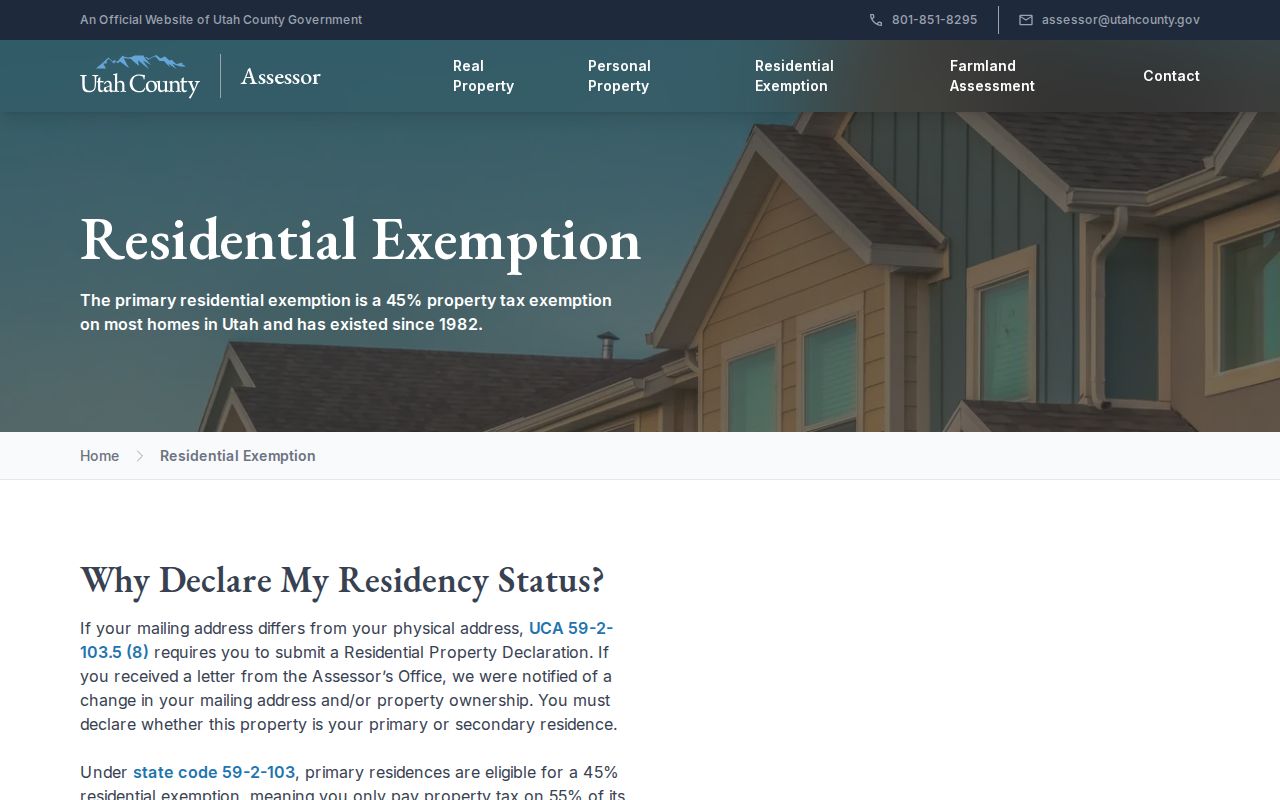
Check the treatment on the parcel itself rather than treating the example as a value estimate.
Utah County Assessor Value Fields
Land Records connects a parcel serial to Appraisal Information, Property Values, and Property Valuation. The county advertises owner name, situs and mailing address, serial, subdivision/development, appraisal, market/assessed/taxable value, value history, tax history, delinquency and payoff, map, serial history, and recorded abstract. A live serial-specific card may expose additional details, but exact land/improvement labels and the last-sale display were not confirmed as universal.
| Property Values | Value figures and history by serial |
|---|---|
| Property Valuation | Valuation notice information |
| Tax Information | Tax history and account detail |
| Parcel Map / Serial History | Location and parcel-system context |
| Recorded Abstract | Linked recorder documents where available |
The Utah County Assessor links the Land Records search and describes the office's role in setting values.
Treat the value detail as an assessor record. Then compare it against a separately recorded deed.
Utah County Property Sale Prices
A recorded deed can supply the transfer date and the parties. It may also show the instrument description, book/page or entry, a parcel cross-reference, and an image when available. The sale consideration may appear in the instrument or parcel detail. No single universal price field exists across records. If the price is not shown, do not infer it from the assessed value or from a nearby sale.
Match the deed's date and legal description to the parcel you are studying. A deed can convey a partial interest. It can cover more than one parcel, or name a trust or entity. A sale price proves one past event. It is not an appraisal of the property today.
Utah County Valuation Notice Timing
Utah County mails valuation notices around July 22. Hearings before the Board of Equalization follow in August. Those dates open the review window for the assessor's value. They do not signal a tax bill. A notice and a bill are separate records. Appeals are due September 1, so the calendar moves quickly once the notice arrives. Save the notice year and value field with the parcel serial.
For the value itself, open Property Values and Valuation Notice. Bills, exemptions, payoff, and the appeal process belong on the county tax screens. Those screens carry current instructions. This lookup stops at the meaning and location of the figures. It will not calculate a tax bill or predict what a home will sell for.
A primary residence usually gets the county's 45% exemption once the occupancy test is met. That leaves 55% of fair-market value taxable before the local rate. Qualifying occupancy means at least 183 consecutive days. That period applies to an eligible owner, spouse, family member, or full-time tenant. The mailing address may differ from the situs. Then a declaration may be due within 90 days of the county letter. Check the exemption field first. Two similar market values can produce different taxable figures when exemption status differs.
Preserve the notice and assessment year through any appeal. The county calendar places Board of Equalization hearings in August. The appeal deadline lands on September 1. A valuation notice states the Assessor's figure. A Treasurer bill shows the amount due under local rates and the account status. Keep those documents separate when weighing the change that prompted the review.
Find a Utah County Assessed Value
Utah County's menu separates Property Values, Property Valuation, and Tax Information. Start with the address. Use the parcel serial to open the value screens. Save the date or assessment year with each number, so an older value is not confused with a current bill or a later sale.
- Search the Utah County Land Records directory by address or owner name.
- Copy the correct parcel serial and confirm the situs and legal description.
- Open Property Values and Property Valuation for the assessed and market figures shown.
- Check the exemption field before comparing taxable value with market value.
- Use the recorded deed for a past sale reference if the transaction detail is available.
- Market value
- The Assessor’s estimate of full property value.
- Assessed value
- The value used on the assessment roll.
- Taxable value
- The part of value subject to tax after an applicable exemption.
- Sale consideration
- The amount or terms shown in a recorded transfer, when available.
- Reassessment
- A later assessor value update; the county calendar gives the notice and review timing.
Utah County Land and Improvement Detail
The Assessor's inventory advertises appraisal information, value history, and value detail. Even so, parcel cards do not always show a consistent land-versus-improvement breakdown. Check the record you select. Note which field labels are actually present. Never fill a missing component with an estimate. Do not use an aerial image or a nearby parcel.
The Assessor result may provide component detail. Keep it with the total value and the year. A change may reflect the parcel record or assessment treatment. It may not reflect a recent arm's-length sale. The Utah County Assessor determines value and exemptions. A licensed appraisal is a separate professional product.
For year-to-year comparison, save the parcel serial, valuation year, field label, and amount together. Compare components only within the same record year. Never mix one year's land figure with another year's improvement figure. A taxable amount also differs from a tax balance. The balance can include a bill period, penalty, interest, or delinquent charge. Keep the labels straight. If a card lacks a detail, ask the Assessor about that parcel. Do not estimate the missing value from the map or a nearby sale.
Limits of Utah County Property Value
An assessor value is not a promise of a sale price. It is not a loan appraisal or a parcel boundary either. It is a county tax-roll figure. Markets can move after a value date. A deed price belongs to one earlier transaction. Read the number through its source and date. Ask a licensed appraiser when a current opinion of market value is needed.
Value vs. price. A Utah County assessor value serves taxation and is not what a property will sell for. It is not an appraisal.